Guide
Children's Room Door Sign: The Ultimate Parents' Guide

Name Plate & Door Sign for the Children's Room: The Parent's Guide to Style, Orientation & Small Well-being Rituals
A child's room is more than just a room. It's a sanctuary, a play world, an island of comfort, and sometimes even a "do not disturb" zone. A personalized door sign or name plate makes exactly that visible: A little person with a big personality lives here. In this guide, you'll get selection help, ideas for the hallway, and a psychological perspective: Why clear labeling helps children to understand boundaries – and how you can also visually enhance your home.
2) Psychology: Identity, security & "my door"
3) The hallway as a stage: How to visually enhance the entrance area
4) Selection guide: Which name plate suits your child?
5) Sizes, contrasts & legibility: So that it really works
6) Personalization that touches: Name, symbols, colors & small messages
7) Family situations: Siblings, shared rooms, new routines
8) Mounting & placement: Where it looks best (and makes sense)
9) Care & longevity: So that it stays beautiful for years
10) Mini-Funnel: In 3 steps to the perfect children's room door sign
1) Why a door sign for the children's room is so much more than just decoration
In everyday life, so much happens incidentally: Jackets on, shoes off, bag down, quickly a "Where is my...?". A personalized door sign brings calm into exactly this situation – because it creates orientation and at the same time sets a small ritual. The children's room door is no longer "the door on the right", but the door with the name.
- Orientation: Guests, grandparents, babysitters – everyone immediately finds the right room.
- Appreciation: The name on the door signals: "You are important. This room belongs to you."
- Order in the mind: Clear assignment creates less friction (and less "Why are you in my room?!").
- Atmosphere: Wood looks warm, calm and suits modern as well as classic children's rooms.
Product recommendation (Timeless & calm – fits in almost any room)
When the child quietly closes the door in the evening, looks back one more time – and their name is there. That's not a "decor effect". That's a small anchor.
2) Psychology: Identity, Security & "My Door"
Children develop their self-image not only through words, but also through visible signals in everyday life. A name plate is such a signal: consistent, clear, friendly. It marks belonging – and helps to learn boundaries. Especially in family life, boundaries are often the most difficult part: Who can enter when? When is playtime, when is quiet time?
One's own name as a designed object acts like an "I am at home here" statement. For children, this can be emotionally strong – especially in phases where much is new (start of daycare, beginning of school, moving).
A clearly marked door makes it easier to accept the room as a private retreat – even for siblings. The sign is not "demarcation", but a signal of respect: a small world of its own lives here.
When a door sign helps to defuse conflicts
In many families, mini-conflicts arise not from "malice", but from unclarity: Who needs space right now? Who needs quiet? Who wants to show what they have built? A door sign alone doesn't solve this – but it supports clear, child-friendly rules.
- Door sign = "fundamental right": The room is fundamentally the child's private space.
- Practice knocking: "If the name is on the door, we knock." (Yes – even for younger siblings.)
- Add a stop signal: Optionally a small "Please knock" symbol or an agreement like "If the door is ajar, it's quiet time".
Tip: Children love clear rules if they are consistent – and a sign on the door makes these rules visible.
Product recommendation (Statement look that strongly emphasizes "own area")

Wooden Name Plate XXL – personalized for the children's room
Large, present, high-quality: ideal if you want to consciously stage the door or wall as "Here begins your area".
3) The Hallway as a Stage: How to Visually Enhance Your Entrance Area
The hallway is often the most underestimated space: a thoroughfare, a storage area, a zone of chaos. That's precisely why it's worth it. A door sign there is not "just for the child," but also for the feeling of home: It turns a hallway into a home with personality.
Product recommendation (Design that immediately creates a "Wow" effect in the hallway)

Personalized Wooden Door Sign for Children's Room (3D)
Elegant and child-friendly: looks high-quality in the hallway and at the same time playful enough for the children's room.
- One sign per door in the same style (similar material & typography).
- Limit colors to 1–2 accent colors (e.g., black + natural / white + pastel).
- If possible: Keep fittings/handles in one metal color (looks "tidy").
4) Selection Guide: Which Name Plate Suits Your Child?
The selection becomes easy if you don't look for "the most beautiful", but for the most suitable. Ask yourself three questions: style, character, and effect.
Calm lasts longer and looks "grown-up". Striking brings joy – and sometimes that's exactly what a child's room needs.
Sports, animals, stars – themes can be great if they really suit the child. Neutral remains timeless.
Product recommendation (for small sports fans – maximally personal)

Personalized Door Sign – Sports Name Plate made of wood
If sports are "part of the personality": jersey look + name + number – a real favorite moment at the door.
Product recommendation (classic door sign look – very versatile)
5) Sizes, Contrasts & Legibility: So that it really works
Many signs are "nice," but not effective – because they are too small or disappear in the hallway light. Good legibility is not a detail question, but part of the effect: orientation and value.
- Test distance: Stand 2–3 meters away. Can you read the name easily?
- Choose contrast: Light door + very light lettering = invisible. Better a clear contrast.
- Avoid too many details: Symbols are great – but the name must remain the main character.
- Fewer words, more impact: Name + 1 symbol is often stronger than Name + 3 lines of text.
If you want "maximum visibility": XXL works
A large sign not only appears more legible, but also more consciously designed. Especially in long hallways or with several doors next to each other, a large format immediately creates structure.
Wooden Name Plate XXL – 3D Letter & Name
Ideal for long names, large doors, or if you want to use the children's room door as a design statement.
6) Personalization that Touches: Name, Symbols, Colors & Small Messages
Personalization is strong when it is not "full" – but precise. The goal is not: everything on it. The goal is: It feels like your child.
- First name as an eye-catcher (clear, legible, prominent)
- A symbol (star, heart, flower, ball – appropriate, not arbitrary)
- A color as an accent (instead of a "colorful mix")
- Too many fonts (quickly looks restless)
- Too much text (loses legibility, loses elegance)
- Trends that are "over" in 6 months (if you want long-term enjoyment)
Door sign + "favorite place" feeling (wall or door staging)
A name plate can do more than just mark: it can "open" the room. Many parents deliberately place it in such a way that it sets the first warm impression upon entering – similar to a small welcome.
Product Recommendation (Acrylic + Wood – Modern 3D Look with Strong Impact)

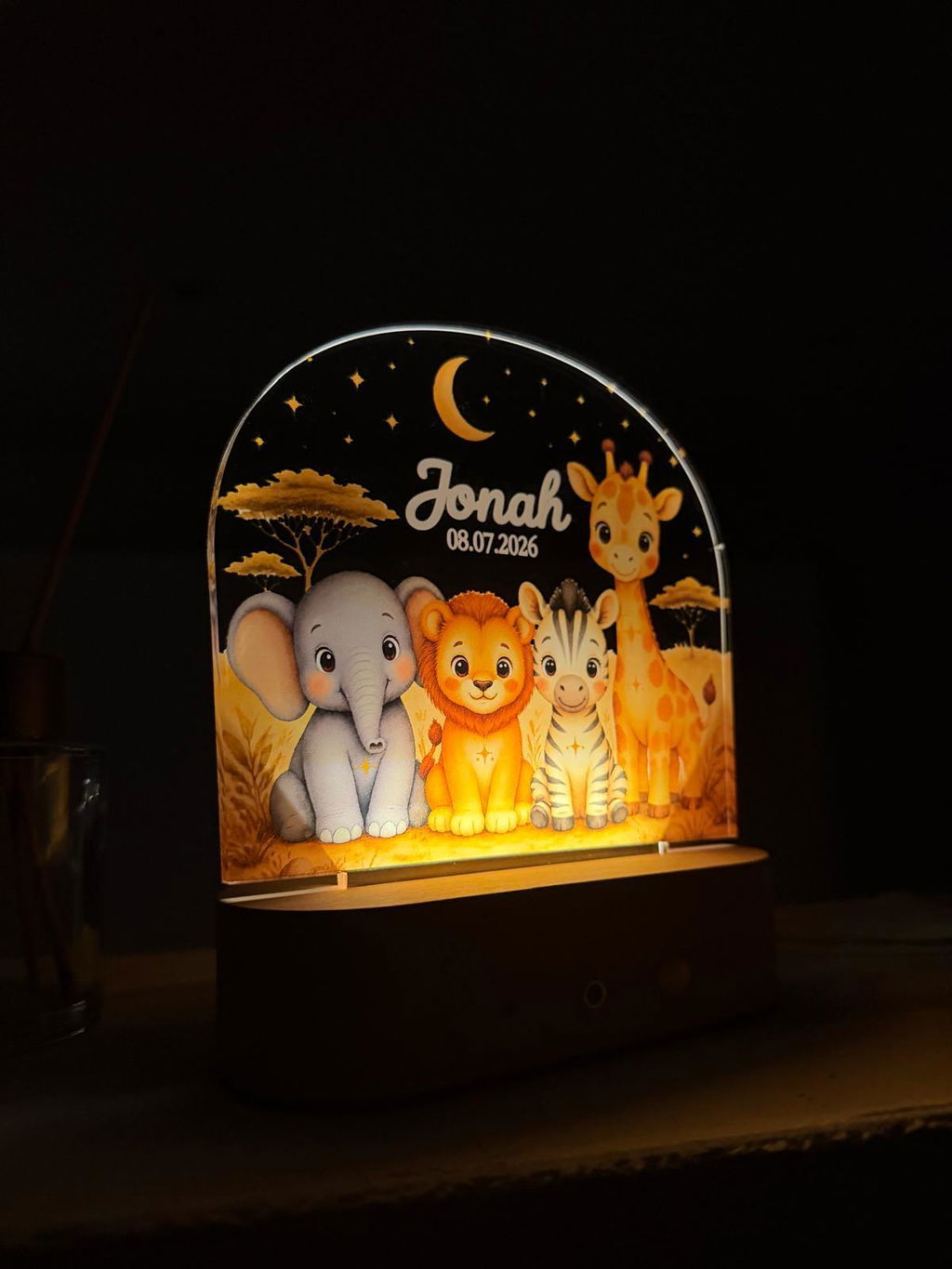
Children's Room Name Plate – Personalized Lettering Acrylic & Wood
Modern, high-quality, clear: the 3D effect works especially well on light doors and walls.
Pro-Tip: If you can't decide between "cute" and "timeless": choose a timeless sign, and add "cute" with an interchangeable decorative element (poster, cushion, garland). The sign will remain.
7) Family Situations: Siblings, Shared Rooms, New Routines
Case A: Siblings (and the classic: "This is my room!")
When children negotiate boundaries, it's rarely about the door itself – it's about attention, security, fairness. A sign can provide relief here, as it creates a clear, visible assignment: This door belongs to this child. This makes rules simpler ("Knock," "ask," "only with permission").
Case B: Shared Room – Two Names, One Space
In shared rooms, the door is the common external boundary. Inside, "micro-zones" are often needed. A nice solution: a common door sign (e.g., "Leni & Emil") – and additional small name elements on the beds or shelves. This creates: togetherness externally, individuality internally.
- Door sign with both names (equally placed).
- One small name element per area (e.g., on the shelf or above the bed).
- Ritual: "We still knock" – even if both live in the same room (respect training).
Case C: Moving, New Home, New Security
After a move, children often look for "fixed points": Where is my place? What belongs to me? A name sign is a quick fixed point – visible on the first day. It says: You have arrived.
Product Recommendation (Classic as Door Sign – Clear, Friendly, Immediately Understandable)
8) Mounting & Placement: Where it looks best (and makes sense)
A door sign can hang "anywhere" – or exactly where it automatically has an effect. If you place it correctly, you get two effects: design + orientation.
- At adult eye level (orients guests & looks high-quality in the hallway).
- Next to the doorknob (classic, clear, "door sign" feeling).
- In the middle of the door (if you want to make a statement, especially with large signs).
- Place it a little lower (depending on age) – this strengthens the "My Name" moment.
- Increase contrast (so it remains visible even in low light).
- Fewer frills (readability over decoration).
- Align all children's room doors (signs always at the same height).
- If multiple doors: choose similar sizes (looks "ordered").
- For patterned wallpaper: prefer a clearer sign design (otherwise it "flickers" visually).
Product Recommendation (Door + Wall Flexible, Looks "Decorated")
9) Care & Longevity: So it Stays Beautiful for Years
A good sign should not look "worn" after two months. Wood is robust, but it loves simple care: dry, gentle, without aggressive cleaners.
- Wipe with a soft, dry cloth.
- No harsh cleaners, no scouring pads.
- Avoid direct strong sunlight if you want colors to stay fresh for as long as possible.
Children's rooms are meant to be lived in. Small traces are part of it – the important thing is that the sign remains stable and does not "deteriorate" visually.
Product Recommendation (Modern & Stable – Ideal as a Lasting Keepsake)
Children's Room Name Plate – Acrylic & Wood
If you want a particularly clear look that still appears high-quality after years.
10) Mini-Funnel: In 3 Steps to the Perfect Children's Room Door Sign
Do you want to decide quickly without overthinking 30 variants? Follow this path:
- Choose effect: calm & timeless / modern & 3D / statement (XXL) / theme (e.g. sports)
- Determine personalization: First name + optional symbol + 1 accent color
- Decide on placement: Door (orientation) or wall (decoration focus) – and then order
Bonus Idea: A door sign is also a great gift for a birth, birthday, move, or start of kindergarten/school – because it is not "used up" but remains.
Further Suitable Children's Room Signs (Short & Direct)
Depending on your style, you will find other variants here that are perfect as door signs or name plates for the children's room:
Children's Room Door Sign – Wooden Name Plate
Classic, clear, suitable for everyday use – perfect for door labeling.
Personalized Children's Room Door Sign Made of Wood (3D)
If you want a high-quality, "finished" look.
Children's Room Wooden Door Sign
Versatile and harmonious – fits in modern children's rooms.
Personalized Door Sign – Sports Name Plate Wood
Theme meets personality – especially popular as a gift.